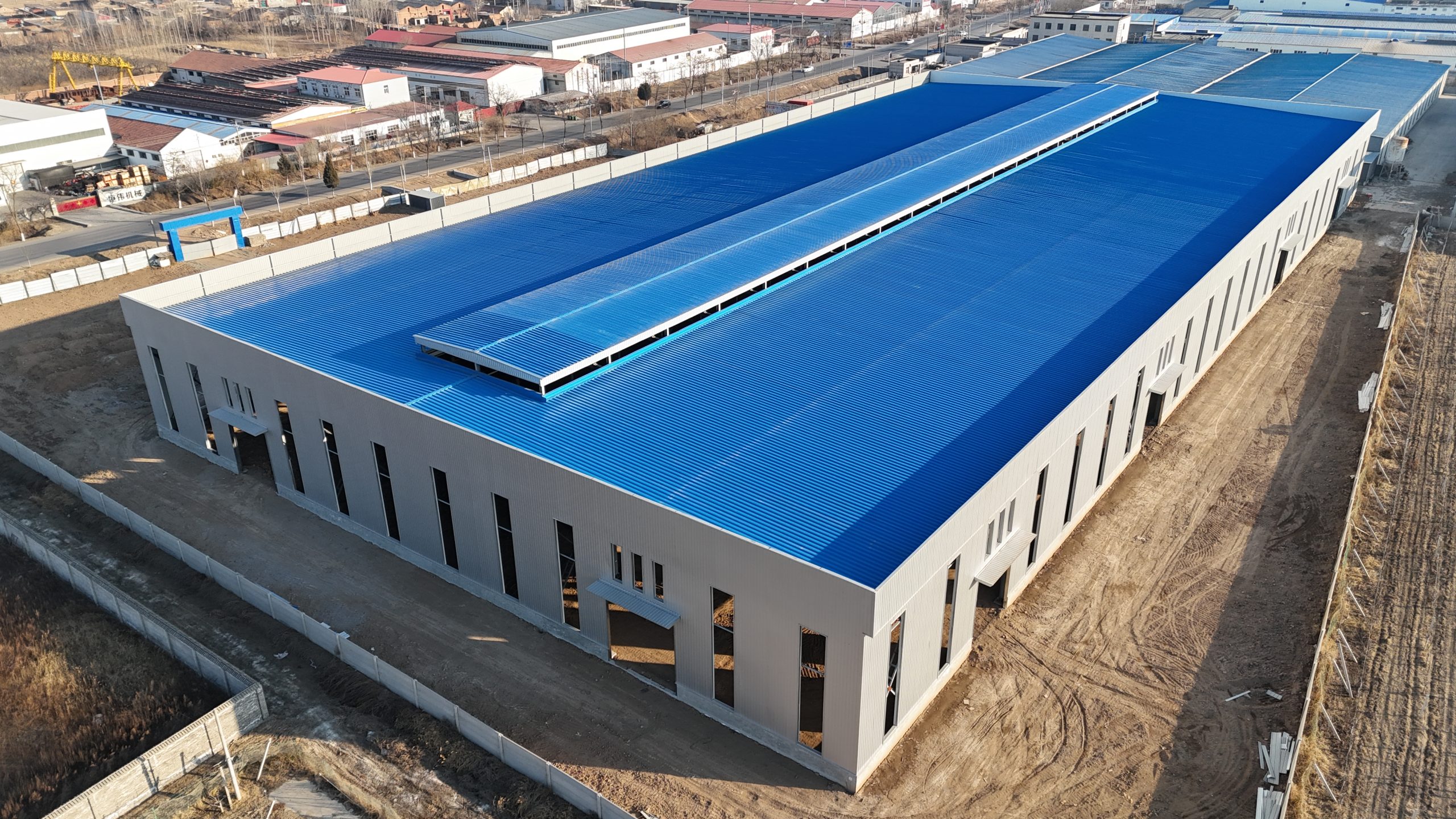
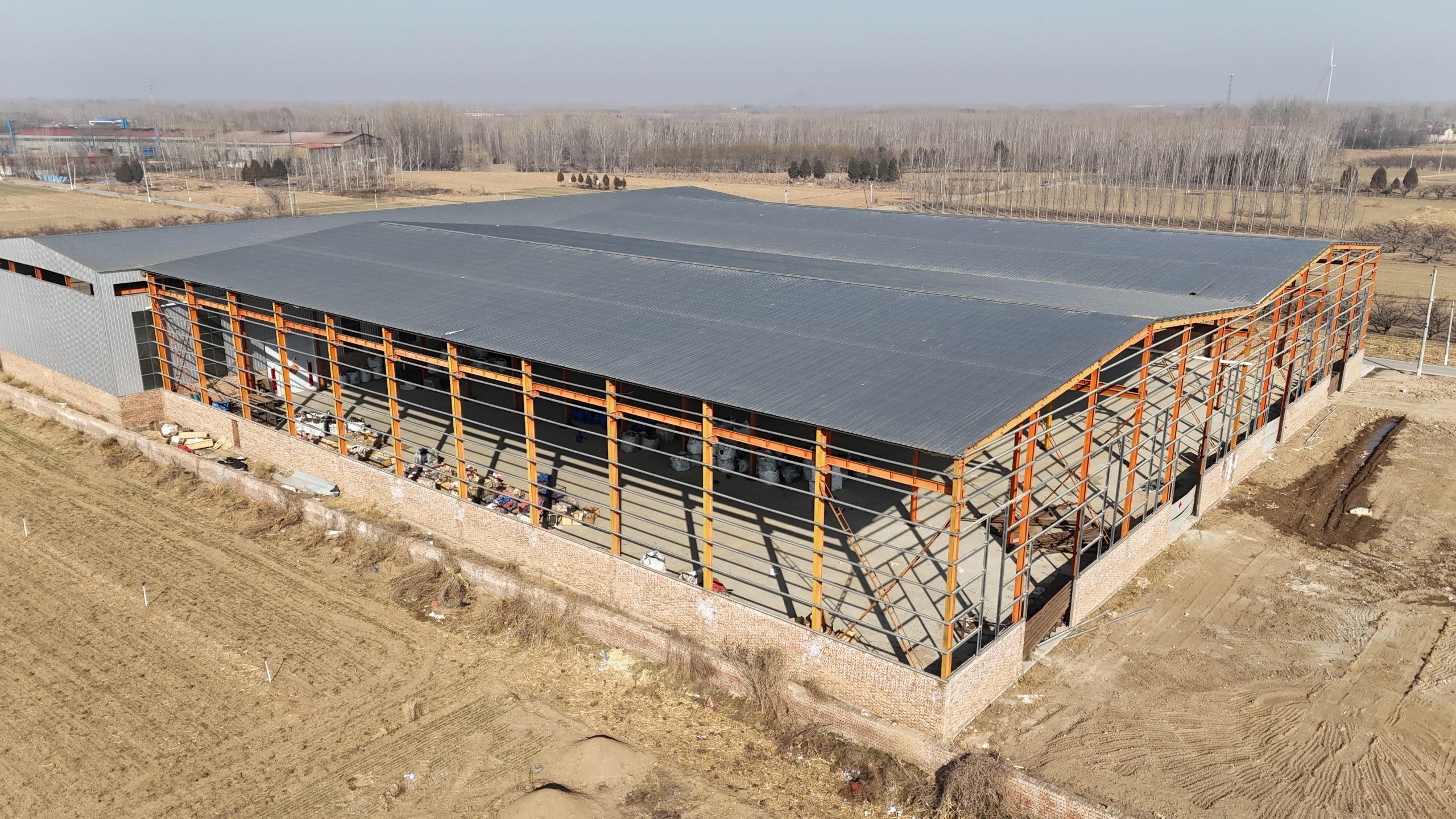
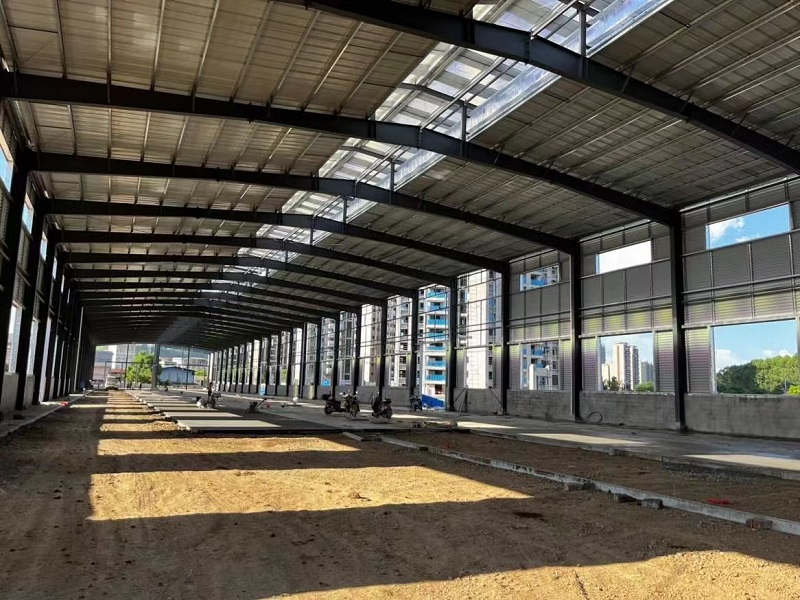
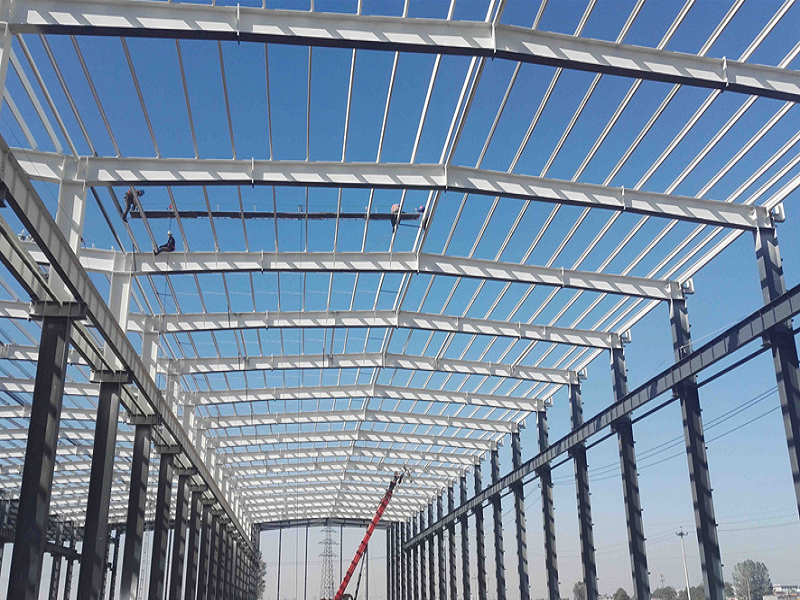
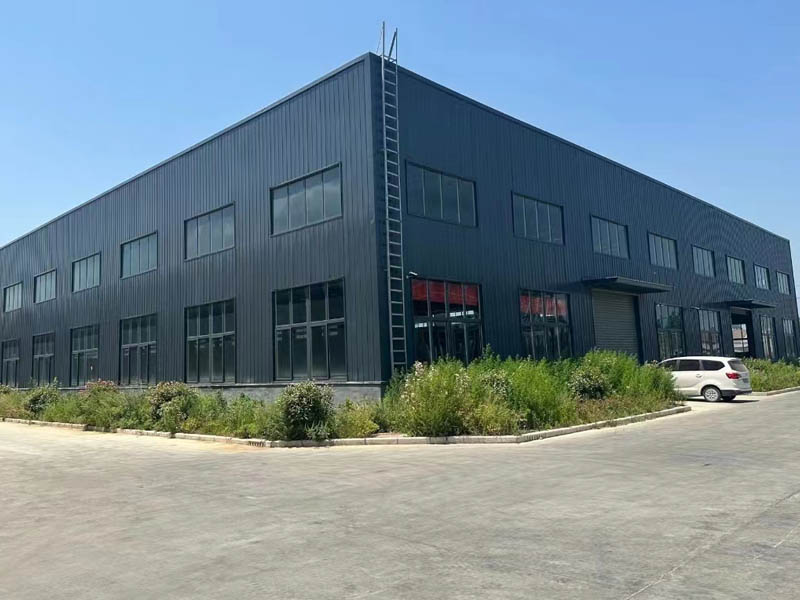
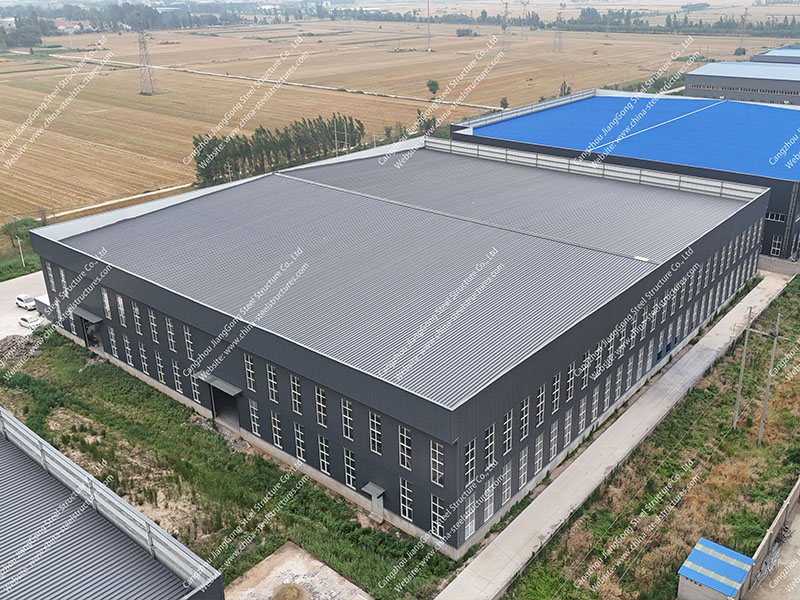
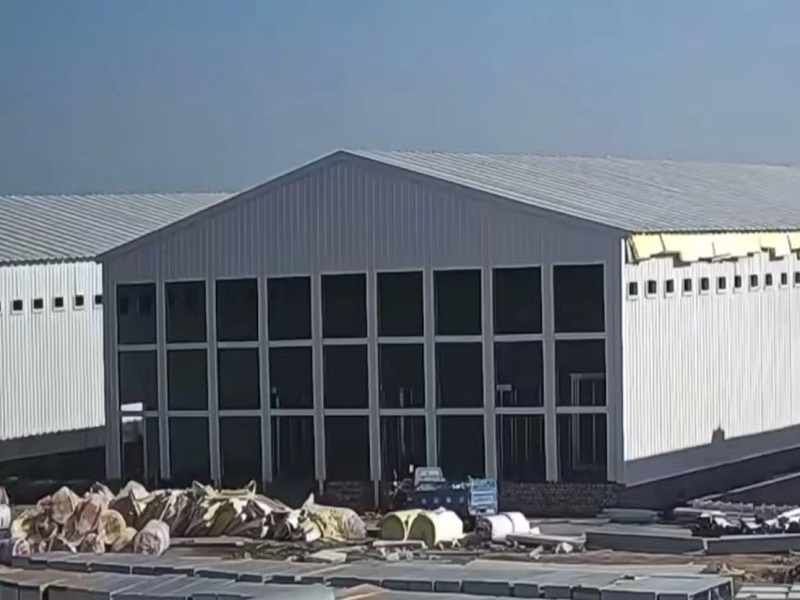
The steel workshop cost most buyers plan around is roughly US $60–$160 per square meter for the fabricated steel frame supplied factory-direct from China, or about US $300–$800 per square meter fully built once you add cladding, an overhead crane, sea freight, the foundation and on-site erection. As with any industrial building, that spread is wide for a reason: a “price per square meter” tells you almost nothing until you know whether it covers the bare frame or a finished, crane-ready factory. For the full method behind these numbers, see our 2026 steel building price guide, and if you are still choosing a material, our comparison of steel versus concrete for factories is a useful companion.
A workshop or factory building is not just a bigger warehouse. It usually carries an overhead crane, needs larger clear spans and higher eaves for machinery, and often includes a mezzanine, heavier floor slab and a proper power and ventilation setup. Each of those pushes the price above a simple storage shed. This guide breaks the steel workshop cost down layer by layer, shows how cranes and spans move the number, and explains how to compare quotes fairly. You can also browse our steel workshop and factory building range to see typical configurations.
Quick answer: steel workshop cost per square meter
The table below is a planning-level snapshot for a single-story steel workshop. Figures are indicative 2026 ranges and depend on your final drawings, the current steel price, the crane you specify and your destination.
| Cost scope | Light workshop (no crane) | Standard workshop (light crane) | Heavy workshop (large span + heavy crane) |
|---|---|---|---|
| Steel frame only — FOB China | $60–$95/m² | $90–$160/m² | $150–$280/m² |
| + Roof & wall cladding (single-skin) | +$18–$28/m² | +$22–$32/m² | +$28–$45/m² |
| + Insulated sandwich panel instead | +$32–$58/m² | +$38–$65/m² | +$45–$75/m² |
| Fully built (frame + cladding + foundation + erection) | ~$300–$480/m² | ~$400–$620/m² | ~$550–$800+/m² |
In imperial terms, that frame range is roughly $5.5–$15 per square foot and the fully built range about $28–$74 per square foot. As a rule of thumb, the steel frame is usually only 30–45% of a finished workshop; the rest is cladding, the crane, freight, the concrete foundation and slab, and local erection. That is why a factory quoting “$100/m²” and a contractor quoting “$500/m²” can both be honest — they are pricing very different scopes.
The biggest workshop cost driver: the overhead crane
The single factor that separates a workshop price from a warehouse price is the overhead crane. A crane does not just add its own equipment cost — it forces the whole structure to carry moving, dynamic loads, so columns get heavier, dedicated crane beams (runway girders) are added, brackets and bracing are reinforced, and total steel tonnage rises. The heavier the crane, the more steel your steel workshop cost has to absorb.
| Overhead crane capacity | Typical use | Effect on the steel frame |
|---|---|---|
| No crane | Assembly, storage, light production | Baseline tonnage; lowest cost |
| Up to 5 tons | Light machining, small fabrication | Modest increase in columns and beams |
| 5–10 tons | General manufacturing, steel fabrication | Noticeably heavier frame and crane beams |
| 10–20 tons | Heavy machinery, large components | Substantially heavier structure; higher eaves |
| 20 tons and above | Heavy industry, steel mills, precast plants | Major redesign; often the top of every range |
The practical takeaway: specify your crane accurately before you ask for a price. Under-stating it means a redesign later; over-stating it means paying for steel you never use. Tell the manufacturer the capacity, how many cranes, and the lift height, and the frame can be engineered to match rather than guessed at.
Steel workshop cost by size
Larger workshops usually cost a little less per square meter, but the effect is gentler than with plain warehouses because span and crane requirements tend to rise with size too. The examples below assume a standard production workshop with a light-to-medium crane; treat them as planning brackets, not fixed prices.
| Workshop size | Floor area | Steel frame (FOB, est.) | Fully built (est.) |
|---|---|---|---|
| Small | ~500 m² (5,400 ft²) | $40k–$75k | $160k–$300k |
| Medium | ~1,500 m² (16,000 ft²) | $120k–$225k | $500k–$900k |
| Large | ~3,000 m² (32,000 ft²) | $240k–$450k | $1.0M–$1.8M |
| Very large | ~5,000 m² (54,000 ft²) | $380k–$720k | $1.6M–$3.0M |
Notice the “fully built” totals are dominated by local work — foundation, slab and erection labor — which is why the same building lands at a very different price in a low-labor market than in a high-cost one. The frame, the part you buy from China, is the most predictable line and the one you can lock down early.
Steel workshop cost by building type
How the building is used shifts the per-square-meter cost, because use dictates the crane, span, height and envelope:
- Assembly / light production workshop — the most economical type. Modest loads, a light crane or none, and a simple envelope keep it near the lower end of every range above.
- Fabrication / machining workshop — mid-range. A 5–10 ton crane, wider spans and insulation for a working environment push tonnage and price up.
- Heavy industry (steel mills, precast, heavy machinery) — the highest cost. Large spans, heavy or multiple cranes and tall eaves put these at the top of every range.
- Processing plants (food, agricultural, packaging) — variable. The frame is often standard, but hygiene, insulation or temperature control can add heavily to the envelope layer.
Knowing your workshop type up front lets a manufacturer quote the right frame weight and crane instead of a generic average — which is exactly why a scoped quote beats a headline number.
Why a steel workshop costs more than a warehouse
If you have priced a plain storage warehouse, expect a workshop of the same footprint to cost meaningfully more. The reasons stack up: a workshop typically needs a wider clear span so machinery and forklifts can move freely; a higher eave to fit a crane and its hook height; the crane structure itself; a thicker, reinforced floor slab to carry machine loads and traffic; insulation, lighting and ventilation because people work there full-time; and often three-phase power provisions and a mezzanine for offices or QC. None of these apply to a simple shed used only for storage. Individually each is modest; together they lift a workshop into a higher price band. The good news is that steel handles all of them well, and every one of them can be scoped precisely so you pay only for what your production actually requires.
7 factors that change your steel workshop price
Two workshops of the same floor area can differ in price by two to three times. These are the variables that decide where you land:
- Crane capacity and number. The dominant driver, as above — heavier or multiple cranes mean a heavier frame.
- Clear span. A column-free span for production lines uses more steel than a design with internal columns. Wider spans cost more per square meter.
- Eave height. Taller walls for cranes, tall machinery or racking add steel and cladding.
- Roof, snow, wind and seismic loads. A workshop for a snow region, a coastal typhoon zone or a seismic area like the Andes needs a stronger frame, and that means more steel.
- Cladding and insulation. Single-skin sheet is cheapest; EPS, rock wool or PU sandwich panels add insulation and cost for occupied or climate-controlled workshops.
- Mezzanine and floor loading. An office or storage mezzanine and a heavy-duty slab both add material and cost.
- Coatings and accessories. Hot-dip galvanizing, extra doors, skylights, ventilation and lifting equipment all move the total. Strip a quote to structure-only and it looks cheap; a fair comparison must include the same items.
Kit vs. installed: what a workshop quote actually covers
Confusion about steel workshop cost almost always comes from comparing quotes that measure different scopes. There are three:
- Frame only (FOB China): the fabricated steel structure, crane beams included if specified, loaded into containers at our port. This is the figure you compare between factories.
- Landed cost: the frame plus freight, insurance, duty and inland transport to your site.
- Installed / turnkey: everything above plus foundation, slab and erection — the all-in number, most of which is your own local market.
Always confirm FOB versus CIF, and frame-only versus turnkey, before comparing. A serious quotation should list the design basis (spans, height, crane, loads), a steel tonnage figure, the cladding and accessory specification, packing, lead time and payment terms — not just a single “$/m².” If a quote is one number with no scope, ask for the breakdown.
Why source your workshop structure from China
For most overseas buyers, the reason to buy factory-direct from China is straightforward: a mature, high-volume steel fabrication industry produces engineered structures at a lower cost per ton than most local markets, and the flat-packed frame ships economically in containers. Because a workshop frame is heavier than a warehouse frame — more steel, more welding, crane beams — the per-ton saving from Chinese fabrication makes an even bigger difference to the total. Buyers in the United States, Latin America, Africa and Southeast Asia combine our low structure cost with their own local foundation and erection, and land a complete factory well below a fully local build. Plan for freight, lead time and customs; for most workshops those are comfortably outweighed by the structure saving.
Regional notes: US vs. Latin America and emerging markets
Because foundation and erection are local, the same frame lands at different all-in prices by country. In the United States, higher construction wages push the fully built figure toward the upper end of the ranges here, though buyers still gain from the lower structure cost and faster build. In Latin American markets such as Colombia and Peru, and across much of Africa and Southeast Asia, lower erection labor often brings the installed cost toward the lower end — while import duty, inland transport to interior or highland sites, and seismic design for regions like the Andes all need budgeting. Many buyers in these markets ask us to quote the frame in US dollars and design to local wind and seismic codes, then handle the foundation and crane installation with a local crew. Whichever market you are in, the frame is the controllable saving; the exact steel workshop cost firms up once your crane, dimensions, loads and destination are set.
Want the real number for your workshop? The ranges here are for planning. Your exact steel workshop cost depends on your span, eave height, crane and destination. Send us your dimensions, crane capacity and location and we will prepare a detailed FOB quote, usually within 24 hours. Contact us for a free quote or message us on WhatsApp.
How to get an accurate steel workshop quote
To turn these estimates into a firm price, have six details ready: your dimensions (width × length × eave height); your crane requirement (capacity, number of cranes, lift height); your location, so we design to the correct wind, snow and seismic code; whether you need a clear span or can accept internal columns; your cladding choice (single-skin or insulated panel); and any extras such as a mezzanine, offices or heavy floor loading. With those, a proper quote takes very little time and will be far more reliable than any per-square-meter rule of thumb.
Frequently asked questions
How much does a steel workshop cost per square meter in 2026?
As a fabricated frame FOB China, a steel workshop cost typically runs about $60–$160/m² for light to standard buildings, rising to $150–$280/m² for large spans with a heavy crane. Fully built — including cladding, foundation and local erection — the all-in figure is commonly $300–$800/m² depending on spec and your country’s labor and duty.
How much does an overhead crane add to the cost?
A crane raises cost in two ways: the crane equipment itself, and the heavier frame needed to carry it (heavier columns, crane beams and bracing). The bigger the capacity, the larger both effects. Specify the exact capacity and lift height so the frame is engineered to match rather than over-built.
Is a steel workshop cheaper than a concrete factory?
In most cases, yes. A steel workshop is usually around 20–30% cheaper to build than an equivalent concrete building, goes up faster, and needs a lighter, cheaper foundation. It is also far better suited to carrying an overhead crane, which is why most industrial workshops are built in steel.
Does the frame price include the foundation and crane?
Not usually. An FOB frame price covers the fabricated steel structure (crane beams included only if specified). The concrete foundation and slab are poured locally and priced in your own market, and the crane equipment is often a separate line. Always confirm exactly what a quote includes.
How long does it take to build a steel workshop?
Fabrication of the structure usually takes several weeks, running in parallel with your site preparation, plus ocean transit for international shipping. On-site erection is fast because components are bolted together. Overall, steel construction is commonly 30–50% faster than concrete methods.
Can you ship a steel workshop to my country?
Yes. Fabricated steel workshops are flat-packed into shipping containers and exported worldwide. We regularly ship to Latin America, Africa, North America and Southeast Asia. Freight cost and import duties depend on your destination port and are quoted per project.
What size workshop do I need?
Start from your production layout: the machinery footprint, movement space, crane coverage and any mezzanine or office. It is usually cheaper to build slightly larger now than to extend later, so if you expect to grow, size the frame accordingly and tell us at the quote stage.
The bottom line
The honest answer to “how much does a steel workshop cost?” is that it depends on your building — above all on the crane and span you need — but it should never depend on a vague quote. The fabricated frame from China is the most predictable and controllable part of your budget; the foundation and erection are local and vary by country. Once you know your dimensions, crane, loads and destination, a proper manufacturer can give you a precise, scoped price you can build a budget around. Send us your details for a free, no-obligation quote and we will break it down line by line.