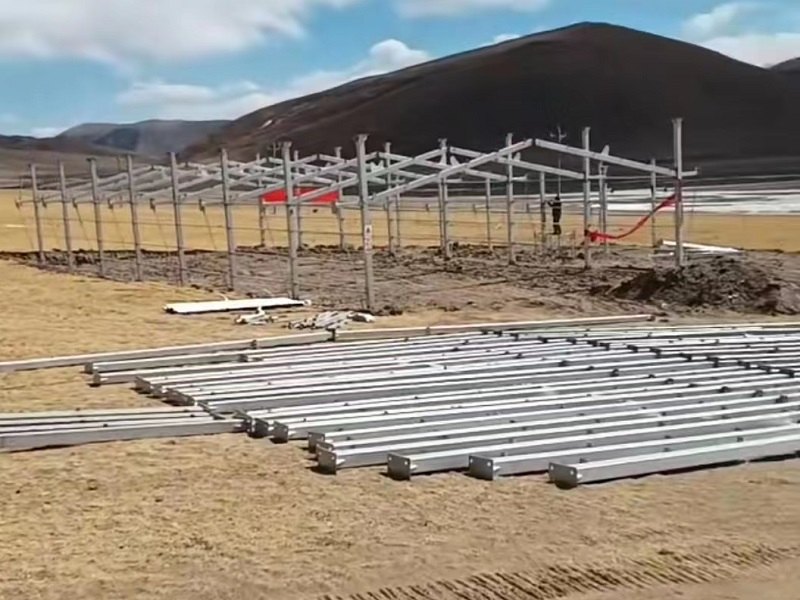
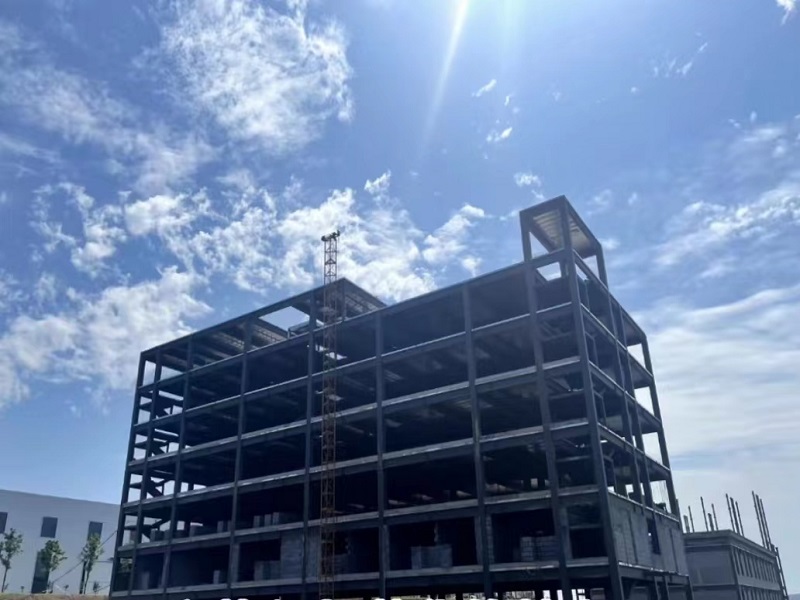
A steel structure warehouse typically costs US $40–$120 per square meter for the fabricated steel frame supplied factory-direct from China, or roughly US $250–$700 per square meter fully built once you add cladding, insulation, sea freight, the foundation and on-site erection. The gap between those two numbers is the single most important thing to understand before you budget: a “price per square meter” figure means almost nothing until you know exactly what it includes. The frame alone, an insulated frame delivered to port, and a complete turnkey building are three very different prices for the same warehouse.
In practice, three things drive your cost more than anything else: the steel tonnage per square meter (which is decided by your span, eaves height and roof loads), the cladding and insulation package you choose, and your logistics plus local site work. For most international buyers, the most cost-effective route is to purchase the engineered and fabricated steel structure factory-direct from a manufacturer in China, ship it in containers, and handle the concrete foundation and steel erection with local labor. This guide breaks the price down layer by layer, gives you realistic ranges and worked examples, and shows you how to compare quotes on a genuine like-for-like basis so you don’t end up comparing a bare frame against a finished building.
Key takeaways
- Steel frame only (FOB China): ~$40–$120/m², depending on span, height, loads and whether a crane is included.
- Fully built warehouse: ~$250–$700/m² all-in; local foundation and erection labor cause most of the variation between countries.
- Biggest cost drivers: steel weight per m² (25–50 kg/m² is typical), insulation type (EPS < rock wool < PU), span/height, and crane or mezzanine loads.
- Steel vs concrete: a steel warehouse is usually 20–30% cheaper to build and needs a lighter, cheaper foundation.
- The number to compare is not “$/m²” but “$/m² including what.” Always confirm the scope of every quote.
Quick-reference: steel warehouse cost per square meter
The table below is a planning-level snapshot. It assumes a standard single-story clear-span building. Prices are indicative 2026 ranges and always depend on your final drawings, the current steel price and your destination.
| Cost scope | Light-duty (simple storage) | Standard workshop / warehouse | Heavy-duty (large span + crane) |
|---|---|---|---|
| Steel frame only — FOB China | $40–$70/m² | $65–$110/m² | $110–$200/m² |
| + Roof & wall cladding (single-skin) | +$15–$25/m² | +$20–$30/m² | +$25–$40/m² |
| + Insulated sandwich panel instead | +$30–$55/m² | +$35–$60/m² | +$40–$70/m² |
| Fully built (frame + cladding + foundation + erection) | ~$250–$400/m² | ~$350–$550/m² | ~$500–$700+/m² |
A useful rule of thumb: the steel frame is usually only 30–45% of the cost of a finished warehouse. The rest is cladding, doors and accessories, freight, the concrete foundation and slab, and the local erection crew. This is why a supplier quoting “$50/m²” and a contractor quoting “$450/m²” can both be telling the truth — they are pricing completely different scopes.
What “cost per square meter” actually includes: the four cost layers
Every steel warehouse price is built from four layers. Getting a quote apples-to-apples means knowing which layers are inside the number.
Layer 1 — The steel structure (the fabricated frame)
This is the primary and secondary steelwork: columns, rafters, purlins, bracing, base plates, anchor bolts and connection hardware, engineered to your loads and cut, welded, drilled and painted in the factory. It is normally sold FOB (Free On Board) from a Chinese port.
The price of this layer is driven almost entirely by how many kilograms of steel your building needs per square meter. A light storage shed might use around 25 kg/m²; a wide-span workshop carrying a heavy overhead crane can exceed 50 kg/m². Multiply that tonnage by the prevailing steel price, add fabrication and a factory margin, and you have the frame cost. Because tonnage is set by engineering — not by marketing — this is where good design saves real money: an over-designed frame quietly adds cost to every square meter.
Layer 2 — Cladding, insulation and accessories
Your building envelope: roof and wall sheeting, skylights, trims and flashings, gutters and downpipes, doors, windows and ventilation. The biggest single choice here is insulation:
- EPS panels — the economical option, fine for basic storage in mild climates.
- Rock wool panels — mid-range, with better fire performance and thermal insulation.
- PU (polyurethane) panels — the premium option, best insulation and durability, used for temperature-sensitive or high-spec facilities.
A simple single-skin steel sheet is the cheapest envelope; an insulated sandwich panel costs more but pays back in energy and comfort for occupied or climate-controlled buildings.
Layer 3 — Shipping and logistics
The fabricated structure is flat-packed and bundled into shipping containers (a 40ft high-cube is common). Freight cost depends heavily on distance, container count and current ocean rates, so it swings far more by route than by warehouse — shipping to Latin America, Africa or Southeast Asia will each price differently, and rates move month to month. The practical advice: get a live freight quote for your specific port, and design for efficient container packing, because a well-nested load can meaningfully lower the freight cost per square meter. Duties and import taxes at your destination are separate and local.
Layer 4 — Foundation and on-site erection
The concrete foundation, floor slab and the labor to bolt the structure together on-site. This layer is almost always handled locally, and it is the one that varies most between countries because it is dominated by local labor rates, soil conditions and foundation type. The good news for steel: because a steel building is far lighter than a concrete one, its foundation is typically 30–50% cheaper, and bolted assembly is fast, which keeps erection labor down.
7 factors that change your steel warehouse price
Two warehouses of the same floor area can differ in price by 2–3× because of these variables:
- Clear span / width. Wider column-free spans need heavier beams and more steel per m². If your operation can tolerate an internal column line, you can cut tonnage and cost.
- Eaves height. Taller buildings carry more wind load and need more steel; height is often necessary for racking or cranes, but every extra meter adds cost.
- Roof and environmental loads. Snow, wind and seismic requirements are set by your site. A warehouse in a high-snow or high-seismic zone is engineered heavier than the same building in a mild climate.
- Crane or mezzanine. An overhead crane dramatically increases loads and steel weight — a workshop with a 5- to 10-ton crane can jump into the heavy-duty price tier. A mezzanine floor adds structure and slab too.
- Insulation level. As covered above, single-skin vs EPS vs rock wool vs PU is a major swing in envelope cost.
- Steel price and tonnage. Global steel prices move, and your design’s tonnage multiplies that movement. This is why quotes have a validity window.
- Doors, finishes and extras. Large industrial doors, extra windows, ventilation systems, fire protection, guttering upgrades and cladding colors all add up.
Sample budgets (for illustration only)
These worked examples show how the layers stack up. Treat them as ballpark ranges, not quotes — your real price depends on your drawings, loads and destination. (Ask us for a tailored quotation and we’ll price your exact building.)
Example A — 1,000 m² simple storage warehouse, no crane, mild climate– Steel frame FOB China: ~$45,000–$70,000 – Single-skin cladding + basic accessories: ~$18,000–$28,000 – Estimated fully built, erected locally: often in the region of $250,000–$400,000 depending on local foundation and labor.
Example B — 2,000 m² production workshop with a 5-ton overhead crane, insulated– Steel frame FOB China (heavier, crane-rated): ~$180,000–$280,000 – Insulated sandwich-panel envelope + accessories: ~$70,000–$110,000 – Estimated fully built locally: commonly $700,000–$1,200,000+ depending on site.
The pattern to notice: as you add span, height, crane capacity and insulation, both the frame and the finished-building cost climb — but the frame’s share of the total often stays around a third to a half, with local site work carrying much of the rest.
Steel warehouse cost by building type
The same per-square-meter logic shifts with how the building is used, because use dictates loads, height and the envelope:
- Storage / distribution warehouse — the most economical type. Simple loads, single-skin or light insulation and no crane keep it at the lower end of every range above.
- Production workshop / factory — usually mid-range. Larger spans, higher eaves and often an overhead crane push tonnage (and price) up, and insulation is common for a working environment.
- Cold storage / temperature-controlled — higher cost. Thick PU insulated panels and vapor sealing add substantially to the envelope layer, even when the frame itself is standard.
- Agricultural buildings (poultry sheds, livestock barns, greenhouses) — often the lowest cost per square meter. Light steel frames and simple envelopes optimized for ventilation rather than heavy loads keep both tonnage and price down.
Knowing your building type up front lets a manufacturer quote the right frame weight and envelope instead of a generic average — which is exactly why a scoped quote beats a headline number.
Steel warehouse cost vs concrete: the short version
If you are weighing steel against a traditional concrete building, the headline is that a steel warehouse is usually around 20–30% cheaper to build, goes up significantly faster, and needs a lighter and cheaper foundation thanks to its low self-weight. Concrete has its own strengths — mass, inherent fire resistance and very low long-term maintenance — so the choice isn’t automatic. We cover the full comparison, including the cases where concrete or a hybrid design makes more sense, in our companion guide: Steel Structure vs. Concrete Building — Which Is Better for Warehouses & Factories?
How to reduce your steel warehouse cost without cutting quality
Cutting price and cutting quality are not the same thing. The savings that don’t come back to bite you are these:
- Optimize the design and tonnage. The cheapest steel is the steel you don’t over-buy. A well-engineered frame sized precisely to your loads is the biggest lever you have. Ask your manufacturer for a design that hits code with efficient tonnage, not a heavy “just in case” frame.
- Use standard spans and modules. Standard bay spacing and spans are cheaper to fabricate than unusual geometry. If your operation allows it, standard dimensions save money.
- Right-size your insulation. Don’t pay for PU panels on a building that only needs single-skin — and don’t cheap out on a climate-controlled facility that will bleed energy for 30 years. Match the envelope to the use.
- Pack containers efficiently. Freight per square meter drops when the structure is nested and bundled well. A supplier experienced in export packing matters here.
- Buy factory-direct. Every trading middleman adds margin. Buying the structure directly from the manufacturer removes a layer of cost.
- Phase large projects. If you’re building big, a modular steel design lets you erect in phases and spread capital.
Buying a steel warehouse from China: how the pricing really works
For most overseas buyers, the reason to source from China is straightforward: a mature, high-volume steel fabrication industry delivers engineered structures at a lower cost per ton than most local markets, and the fabricated frame ships economically in containers. Here is what a professional purchase looks like so the price you’re quoted is the price you can rely on.
FOB vs CIF. An FOB price covers the structure loaded onto the vessel at the Chinese port; you arrange onward freight and pay import duties. A CIF price includes ocean freight to your destination port. Always confirm which you’re being quoted — comparing an FOB price against a CIF price is a common and expensive mistake.
What a complete quotation should include. A serious quote comes with the design basis (spans, height, loads for your specific site), a steel tonnage figure, the cladding and accessory specification, packing details, lead time and payment terms — not just a single “$/m²” number. If a quote is just one number with no scope, ask for the breakdown.
Drawings and approval. Reputable manufacturers provide structural drawings for your review and local engineer sign-off before fabrication. This protects you and ensures the building meets your local codes.
Lead time. Design, fabrication and packing typically take several weeks; add ocean transit for your route. Build this into your schedule.
At Cangzhou JiangGong Steel Structure, we’ve been designing, fabricating and exporting steel warehouses, workshops, poultry and livestock buildings and multi-storey frames since 2018, with projects delivered to the United States, Latin America, Africa and Southeast Asia. We quote a full scope, provide drawings, and can advise on efficient design so you get an accurate, honest price rather than a headline number. You can see examples of buildings we’ve shipped in our delivery and project cases, or browse our warehouse and workshop range.
Frequently asked questions
How much does a 1,000 m² steel warehouse cost?
The steel frame for a simple 1,000 m² warehouse is typically around $45,000–$70,000 FOB China, plus cladding. Fully built and erected locally, a basic 1,000 m² steel warehouse often lands in the region of $250,000–$400,000, with the concrete foundation and local labor accounting for much of the variation.
Is a steel warehouse cheaper than a concrete one?
In most cases, yes. A steel structure warehouse is usually about 20–30% cheaper to build than an equivalent concrete building, and its lighter weight makes the foundation 30–50% cheaper. Concrete can offer lower long-term maintenance in some scenarios, but steel typically wins on total build cost and speed.
Does the price per square meter include installation?
Often it does not. Many “per square meter” prices — especially from manufacturers — cover only the fabricated steel frame (FOB), not cladding, freight, foundation or erection. Always confirm exactly what a quoted figure includes before comparing.
How long does it take to build a steel warehouse?
Fabrication of the structure usually takes several weeks, running in parallel with your site preparation. On-site erection is fast because components are bolted together. Add ocean transit time if the structure is shipped internationally. Overall, steel construction is commonly 30–50% faster than traditional concrete methods.
Can you ship a steel warehouse to my country?
Yes. Fabricated steel structures are flat-packed into shipping containers and exported worldwide. We regularly ship to Latin America, Africa, North America and Southeast Asia. Freight cost and import duties depend on your destination port and are quoted per project.
How long does a steel warehouse last?
With proper protective coating or galvanizing and basic maintenance, a well-built steel structure can last 30–50 years or more. Corrosion protection matched to your climate (especially in coastal or humid regions) is the key to longevity.
What’s included in an FOB steel structure price?
An FOB (Free On Board) price typically covers the fabricated steel frame — columns, beams, purlins, bracing and connection hardware — loaded onto the vessel at the Chinese port. It usually does not include ocean freight, import duties, the concrete foundation or on-site erection, and cladding is only what has been specified. Always ask for the exact inclusions list so you can compare quotes fairly.
Get an accurate price for your warehouse
The honest answer to “how much does a steel structure warehouse cost?” is: it depends on your building — but it shouldn’t depend on a vague quote. Once you know your floor area, span, height, loads and destination, a proper manufacturer can give you a precise, scoped price you can budget around.
Tell us your dimensions and where you’re building, and we’ll prepare a tailored quotation with a full breakdown — steel frame, cladding, packing and lead time — plus advice on how to hit your budget without compromising the structure. Contact our team on WhatsApp or send us your requirements here.